Why a Door Opens into a Room: The Swing of a Hinge
Door swing shapes usable room space: learn how hinge position, opening direction and nearby furniture affect everyday movement through a doorway.
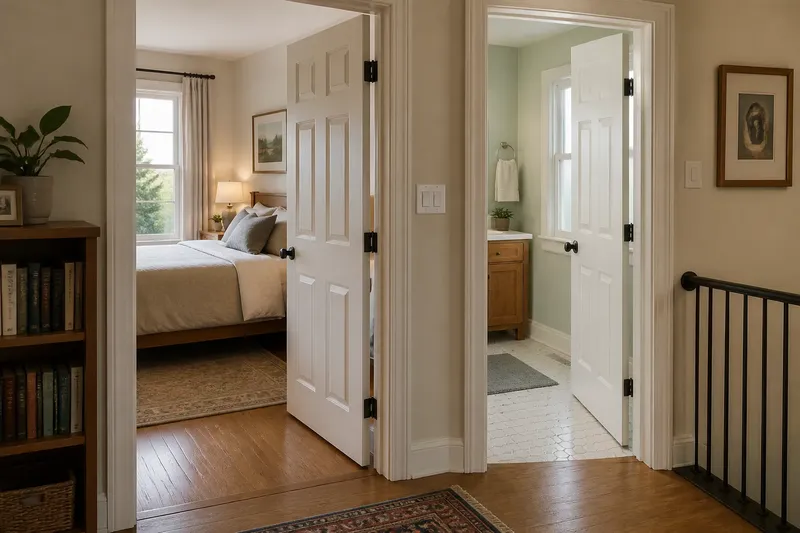
Why does one door open into a room while another swings into a hall, and how much space does that choice really take? A door swing is more than the arc of a door leaf: hinge position and opening direction decide which parts of a room stay clear, where people can pause, and how furniture can sit near the opening.
What does a door swing change in a room?
A hinged door turns around a fixed vertical line at its hinges. As it opens, the free edge traces an arc roughly as wide as the door leaf. That arc occupies floor area, even though it is only used during opening and closing.
The practical effect depends on what lies within that arc. A door may cover part of a wall, block a cupboard, interrupt a route from one room to another, or occupy a corner that could otherwise hold a chair. A clear patch of floor is not automatically wasted: it gives the door room to move and allows someone to use it without squeezing past an obstacle.
It also changes what a person sees on entering. A door that rests against a blank wall can leave the room’s main area visible; one that stops across a window or wardrobe can make the same room feel more crowded. These are small spatial decisions, but they are encountered repeatedly.
Why do most room doors open into the room?
An inward-opening door keeps its leaf out of the shared corridor when it is open. In a narrow hall, that can make passage easier and prevent the door from projecting into the path of someone approaching from the other direction.
Opening inwards can also give the person inside control of the doorway. In a bedroom, for instance, the door can rest against an interior wall rather than occupy a communal route. The arrangement may suit privacy and circulation, but only if the leaf does not collide with furniture or block a useful part of the room.
There is no single direction that works for every room. A small cloakroom may benefit from a door that opens outwards if an inward swing would take up the only clear standing area. In other situations, the outward leaf could obstruct a hall or another door. The decision is about the actual approach and room arrangement, not a universal rule.
How does hinge position decide where the door rests?
Hinges define the pivot. Put them on the left side of the opening and the door rotates from that edge; put them on the right and the arc shifts to the other side. The door’s resting position changes with the hinge side, even when the opening direction stays the same.
Imagine a bedroom door hinged on the side nearest a low bookcase, with the door swinging inwards. The leaf could strike the bookcase before opening fully. If the hinges were on the opposite side, the door might lie against a clear wall instead, leaving the bookcase accessible. The expected observable result is a door that opens without hitting the furniture and a less obstructed route into the room.
Before deciding, look at the door from the side from which it is usually approached, then note which hand reaches for the handle and what sits behind the leaf. A plan drawing can show the arc, but a simple sweep made with a finger on the plan is often enough to expose a clash. For an existing room, stand at the threshold and imagine the door resting fully open; check the wall, switches, furniture and nearby openings along that path.
How can a door swing interfere with furniture and movement?
The most obvious clash is a door edge hitting a bed, table or cabinet. Less obvious is a door that opens but leaves too little space to reach a drawer, pass someone, or stand comfortably at the handle. A layout can technically fit while still feeling awkward in use.
Consider a dining-room door that opens across the end of a table. The leaf might not touch the table, yet it can make the nearest chair difficult to pull out. Moving the table may solve the problem, but it might also narrow the route through the room; reversing the swing could help only if the hall has enough clear space.
Check the whole sequence of movement rather than only the door’s resting point. Someone entering carries the leaf through its arc, steps aside, and then walks towards the room’s destination. A good arrangement lets those actions happen without a sharp sidestep or a chair being moved first.
- Trace the full door arc, not just the position when it is open.
- Check whether the leaf meets furniture, a radiator, a cupboard handle or a projecting sill.
- Look for switches and controls that could end up behind the open door.
- Consider whether someone can stand at the handle without blocking another route.
- Open neighbouring doors in your mind at the same time and look for overlapping leaves.
What is not worth the effort is rearranging an entire room around a door that is used rarely before checking a simpler option, such as moving a small piece of furniture or choosing a better hinge side. The right response depends on how the space is actually used.
What should you consider before changing a door’s swing?
Start by identifying the problem precisely. Is the door striking something, blocking a route, hiding a switch, or making the room difficult to enter? A clear description helps distinguish a swing problem from a furniture-placement problem.
Then compare the available directions on both sides of the opening. Ask where the door would rest, whether it would narrow a passage, and how it would interact with other doors. A door that solves one collision can create a new one just outside the room.
Also consider the door’s everyday job. A pantry door may need to leave shelves reachable; a bathroom door needs a clear approach and usable space inside; a bedroom door may be positioned to keep the bed or wardrobe accessible. The best swing is the one that supports the room’s normal actions, not simply the one that produces the neatest plan.
Changing hinges or reversing a door can involve the frame, latch, stops and hardware, not just moving the hinge leaves. Building rules and manufacturer instructions can affect the appropriate arrangement, so check those where relevant and ask a qualified tradesperson if the change involves a fire door or other regulated opening.
Which way should a door open in these common situations?
Should a bedroom door open into the bedroom?
Often, an inward swing keeps the door out of the hall, but it needs a clear place to rest inside the room. Check that the open leaf does not hide a switch, obstruct a wardrobe or meet the bed.
Should a bathroom door open inwards or outwards?
Either direction may work, depending on the room and the passage outside. An inward swing should not consume the only usable standing space, while an outward swing should not obstruct a corridor or another opening.
Which way should a cupboard door open?
Choose a direction that leaves the stored items reachable and does not clash with a nearby door or work surface. For paired cupboard doors, make sure each leaf can open far enough for the object that needs to pass through.
How can you tell which side a door is hinged on?
Look for the hinge barrels along one edge of the door; that is the pivot side. To describe its handing clearly, also say whether you are viewing it from the side where the door opens towards you or away from you, since shorthand can vary.
How do door swings affect the feel of adjoining rooms?
A doorway links spaces, but its moving leaf can either reveal or screen the next room. When open against a wall, it may make two areas feel connected. When it rests across the opening, it can create a partial visual boundary even though the passage remains usable.
This effect is especially noticeable in small homes, where a hall, kitchen and living area may share short routes. A kitchen door that swings into the narrowest part of a hall can make the route feel pinched. Reversing it may improve the hall but take useful floor space from the kitchen. Looking at both sides together avoids treating the doorway as an isolated feature.
Door swing is a modest detail with a direct effect on daily movement. To judge a particular door swing, follow the leaf from closed to open, then imagine the route someone takes immediately afterwards. If that route stays clear and the door leaves the useful parts of the room accessible, the hinge is doing its quiet work well.