A Facade Walk for a Rainy Afternoon
A facade walk in light rain helps you read a building’s composition, openings, edges and repeated details without entering or touching it.

Where should you look when rain turns a building’s front into a patchwork of reflections and darkened surfaces? A facade walk gives you a calm way to read one building from the pavement, moving from its overall composition to its openings, edges and repeating details. The trick is to slow down when a view gets confusing rather than trying to inspect everything at once.
Start with a view that makes the whole facade readable
Choose a public place with a clear view of the building, such as the opposite pavement or a public square. Keep out of entrances, loading areas and private grounds, and do not block the path. A rainy afternoon can make colours richer, but glare, umbrellas and passing traffic may hide useful parts of the elevation.
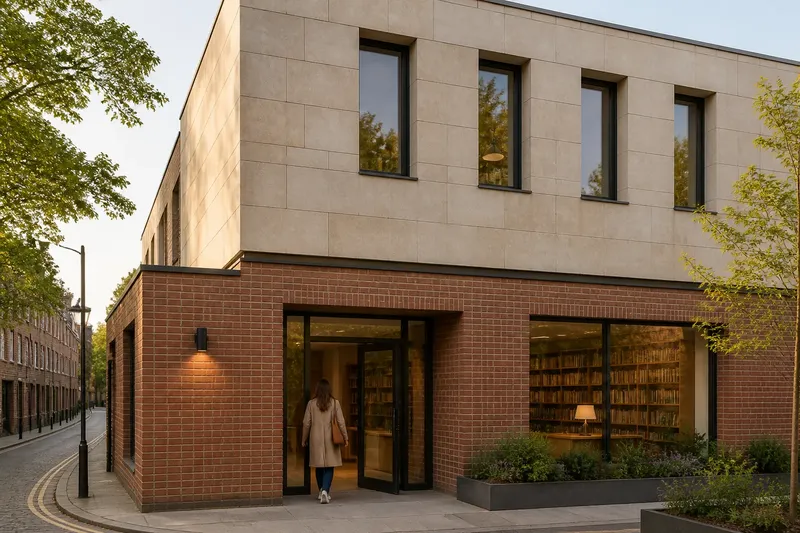
Stand far enough back to see the building’s outline and how its parts sit together. Look for the broad arrangement: a central entrance, a repeated run of windows, a taller corner, a projecting roofline or a quieter section that balances a busier one. You are not trying to identify a style; you are noticing what attracts your eye and what seems to hold the composition together.
If reflections make the facade hard to read, shift along the pavement or wait for a lull in passing cars. Avoid stepping into the road for a better angle. It is not worth chasing a perfect, uninterrupted view: a partial view can still reveal the building’s larger pattern.
When the building feels too busy, look for its largest divisions
A facade can seem like a jumble when signs, shopfronts, drainpipes and window frames compete for attention. Usually the difficulty comes from starting at the smallest scale. Pick out the broad divisions first: ground floor and upper floors, solid wall and glazed areas, or one wing and another.
Then follow a strong line, such as a roof edge, a band of masonry, or the line where one floor meets the next. See whether it continues across the building or breaks at a corner or entrance. Rain can help distinguish materials as surfaces darken differently, though a wet sheen can also disguise texture.
Imagine you are standing opposite a mixed-use building whose shop signs make its upper floors seem disconnected. Look above the signs for the window rows and a continuous sill band; those features may reveal a simple repeated structure beneath the changing ground-floor display. The observable result is a clearer reading of the facade’s larger order, without needing to approach or touch it.
When windows seem irregular, compare their positions before their styles
Windows attract attention because their frames, panes and reflections are easy to pick out. But a dark pane can look blank, and a reflection of clouds may make two similar openings appear different. Compare position and proportion before judging the glass or frame: do openings line up vertically, repeat in rows, or change near a corner?
Notice the wall around each opening as well. A deep reveal casts a shadow; a projecting surround catches rain; a sill may form a horizontal line. These cues help you distinguish a window’s outline from its reflection. If you cannot tell where glass ends, follow the frame instead of interpreting the image in the pane.
Take care not to turn the walk into a hunt for what lies inside. Curtains, blinds and reflections make interiors difficult to read from outside, and they are not needed to understand the facade. Keep your attention on visible shapes and their relationship to the surrounding wall.
When the edges disappear, follow the places where materials meet
At a corner, roofline or entrance, one surface may conceal another. Rain can make a metal flashing or a painted trim line shine, while a shadow under an overhang can make the edge seem deeper than it is. Look for where one plane stops and another begins rather than guessing what is behind it.
At the base, notice how the wall meets the pavement and whether the facade steps back, projects or changes material. At the top, look for the roof edge, parapet or gutter line from the ground. A view from below distorts proportions, so treat apparent slopes or unevenness as visual impressions, not evidence of a defect.
If foliage, street furniture or an awning hides an edge, move to another public vantage point if one is available. Do not lean over barriers, enter a service area or stand beneath a place that feels unsafe just to complete the view. An obscured detail is simply a limit to record, not a problem you must solve.
When repeated details blur together, choose one and track it
Brick bonds, vents, brackets, balcony rails and small panes can form rhythms that are easy to miss when you scan the entire facade. Pick one feature and follow it across the visible elevation. Note whether it repeats at each opening, only at certain floors, or stops where the building changes section.
Look for exceptions as carefully as repetition. A single larger window, a shifted vent or a different balcony may mark a change in room use or facade composition, though an exterior view cannot tell you the full reason. Describe what you can see first; leave explanations as possibilities rather than conclusions.
Use a notebook or a quick sketch if you want to keep the pattern in mind. A few marks showing window rows, a projecting entrance and the repeated feature are often more useful than a collection of close-up photographs. If you take photographs, do so from a public place and avoid including identifiable people where you can.
What should you do when rain changes the view?
How can you tell a reflection from a facade detail?
Look for a stable frame, joint or shadow that stays in place while the reflected scene changes with your viewing angle. If the distinction remains unclear, record the surface as reflective rather than assigning a material or feature.
Should you walk closer to inspect a small detail?
Only move closer if the pavement remains public, accessible and clear of entrances or other activity. A useful facade walk does not require touching the building, crossing a barrier or approaching a private window.
What if an awning or parked vehicle blocks the lower floor?
Note the obstruction and continue with the parts you can see, or look from another safe public position. The upper facade may still show its main divisions and repeated openings.
How do you know when to stop looking?
Stop when you can describe the broad composition, one pattern in the openings, one edge condition and a repeated detail or exception. More time is not automatically more informative if rain, glare or foot traffic has made careful observation difficult.
Leave with observations, not a diagnosis
Before you move on, put the building into a few plain sentences: what dominates the view, how the openings are arranged, where the edges are easiest to read, and which detail repeats or breaks the pattern. A facade walk works best as a record of visible choices, not a verdict on how a building was made or whether it is sound.
If you want to revisit the same facade, choose a different public viewpoint or a drier moment and compare what becomes clearer. The rainy-afternoon view may be incomplete, but it can still make the building’s composition easier to remember: start wide, follow one feature, and let uncertain details remain uncertain.